

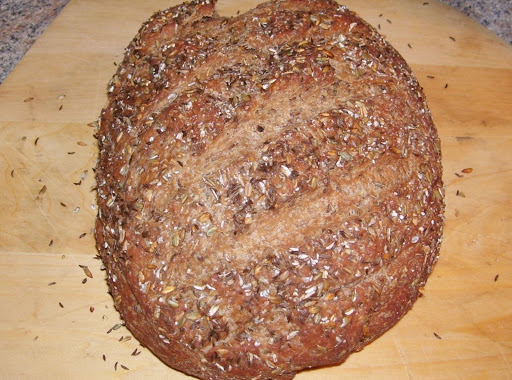
"instant" rye bread

Instant? I wanted a formula for rye bread which was simply dry ingredients and water. Two special ingredients, dried buttermilk powder and vital wheat gluten, were the secret. Rye bread needs acid and in this recipe, dried buttermilk powder serves in that role. Rye flour lacks gluten and the easiest way to increase gluten is to add vital wheat gluten.
prep time
3 Hr 30 Min
cook time
1 Hr 20 Min
method
Bake
yield
variable
Ingredients
- INGREDIENTS ARE GIVEN BY WEIGHT WHICH IS THE EASIEST WAY TO ASSURE THE BREAD WILL WORK WELL
- "BAKER'S PERCENTAGES" ARE ALSO GIVEN. THESE MEASURE ALL INGREDIENTS BY THE PERCENTAGE OF TOTAL WEIGHT OF THE FLOUR(S). A DIGITAL KITCHEN SCALE CAN BE INEXPENSIVELY OBTAINED AT BIG-BOX STORES.
- 450 grams bread flour (75% of flour) -- if you use all-purpose flour, increase the vital wheat gluten to 42g (7%)
- 150 grams rye flour (25% of flour)
- 60 grams dried buttermilk powder (10%)
- 30 grams vital wheat gluten (5%)
- 9 grams salt (1.5%)
- 9 grams instant yeast (1.5%)
- 30 grams caraway seed (optional)
- opt. additional caraway seed, cracked rye, or corn meal to decorate
How To Make "instant" rye bread
-
Step 1The method used here is a variation of no-knead called "Stretch-and-Fold." Although the bread takes several hours, start to finish, it requires very little effort or attention and NO KNEADING!
-
Step 2Place all dry ingredients in a large bowl. Mix THOROUGHLY with a whisk or spoon.
-
Step 3Add the water and stir with a spoon or your fingers until a very sticky dough results and all the dry ingredients have been incorporated. Bring the dough into a rough ball in the center of the bowl.
-
Step 4Cover the dough with plastic wrap and let sit one hour.
-
Step 5Oil a clean surface, such as a counter, and oil your hands. Pull the sticky dough out on to the counter and press/stretch into a rectangle about 11" x 14". If you see or feel any still dry crumbs of flour pinch them to break them up.
-
Step 6Fold the rectangle in thirds as you would a piece of paper to go in an envelope. Then fold in thirds the other way. Put the resulting folded dough back in the bowl. Cover with plastic wrap and let sit a second hour.
-
Step 7Repeat the "stretch and fold" of the dough a second time. Cover and let sit a third hour.
-
Step 8Shape the dough into a neat loaf shape by flattening into a rectangle about 8" x 11" and then rolling up to make an 8" long roll. Seal the ends by turning under and squeezing.
-
Step 9Optionally, roll the dough in additional caraway seed, rye flakes, or cornmeal.
-
Step 10Let the shaped loaf sit 30 minutes to proof while you preheat the oven to 325F. Just before putting the loaf in the oven, slash its top with a sharp knife to allow it to continue to rise as it bakes ("oven spring").
-
Step 11Bake for 1 hour and 20 minutes or until the internal temperature is between 200F and 210F. If the internal temperature is less than 200F, the middle of the bread will be gummy.
-
Step 12BAKING CHOICES: I usually bake this bread on parchment paper and pre-heated quarry tiles. You can put it in a greased and floured loaf pan or on a baking sheet covered in corn meal. If you have good, modern, stick-free pans, it won't stick. If your pans are like mine (old and beat up) it may stick like concrete.
-
Step 13Cool thoroughly before slicing or storing.
- Last Step: Don't forget to share! Post a picture of your finished recipe here and on your favorite social network. Don't forget to tag Just A Pinch and include #justapinchrecipes!
Discover More
Category:
Savory Breads
Tag:
#Quick & Easy
Keyword:
#Rye
Keyword:
#buttermilk
Method:
Bake
Culture:
American
Ingredient:
Flour
Comment & Reviews
ADVERTISEMENT
Just A Pinch Sweepstakes